How Historical Wheel Manufacturing Techniques Influence Modern Random Outcome Reliability in Casino Settings
Katja Neumann · Aug 26, 2026

How Historical Wheel Manufacturing Techniques Influence Modern Random Outcome Reliability in Casino Settings
Wheel manufacturing began in the mid-1700s when craftsmen in France and England shaped roulette wheels from layered hardwoods, ivory pockets, and hand-fitted metal separators; those early techniques established core principles of balance and symmetry that still guide production standards today. Artisans relied on manual lathes and repeated weight checks to reduce mechanical bias, and the same emphasis on uniform mass distribution carries through to contemporary facilities that produce wheels for regulated casino floors.
Foundations of Early Wheel Construction
Records from Parisian workshops show that wheel makers used multiple wood species to create the rotor and stator sections, then inserted brass frets with hand-filed tolerances measured to fractions of a millimeter. Observers note that these methods minimized uneven friction across pocket surfaces, and similar measurement protocols appear in current ISO-aligned manufacturing specifications. Research from engineering archives indicates that deviations larger than 0.2 millimeters in pocket depth already produced measurable outcome skews in period tests, prompting repeated re-balancing steps that remain part of quality checklists.
Industrial Refinements and Their Lasting Effects
By the late 1800s, steam-powered machinery allowed tighter replication of wheel diameters and pocket angles, yet final adjustments still required skilled handwork with jeweler's files and spirit levels. Data from preserved factory ledgers reveal that each completed wheel underwent at least twelve rotational tests under varying loads before shipment. Those same multi-stage verification routines now appear in automated production lines where laser scanners replace manual calipers, while the underlying requirement for concentricity and mass symmetry persists unchanged.
Modern wheel builders continue to source kiln-dried hardwoods for certain components even though polymer composites dominate rotor faces, because historical data demonstrated that wood's natural density variations could be controlled through careful selection and orientation. Technicians apply the same selection criteria when choosing aluminum alloys or carbon-fiber laminates, ensuring that any material substitution meets documented balance thresholds established during the 19th century.
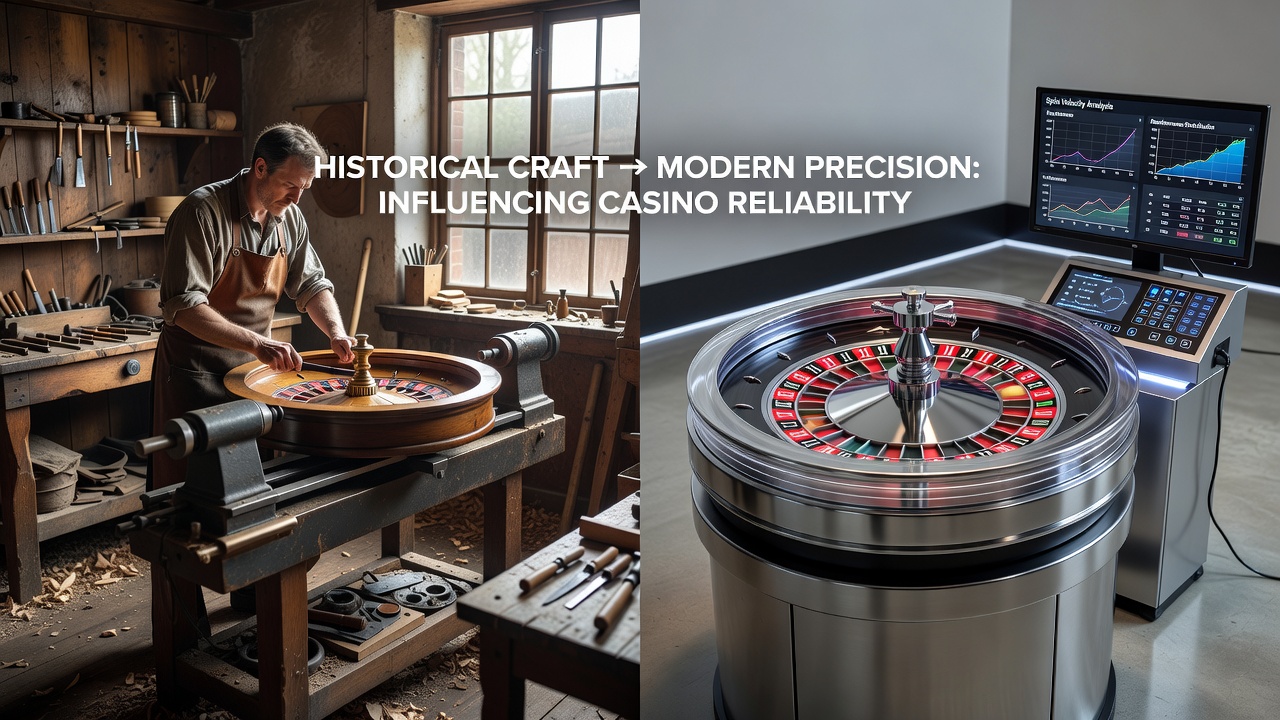
Link Between Historical Methods and Random Outcome Integrity
Studies conducted by gaming laboratories demonstrate that wheels manufactured with attention to historical balance standards exhibit lower bias rates across thousands of spins. Figures released by the Nevada Gaming Control Board show that wheels passing legacy concentricity checks maintain outcome distributions within 0.8 percent of theoretical probabilities over extended trial periods. When manufacturers omit steps derived from early hand-finishing processes, variance increases and regulatory re-testing becomes necessary.
Engineers at facilities supplying North American and European markets still perform static and dynamic balancing sequences that trace directly to 18th-century workshop practices, although they now employ computerized load cells instead of hanging weights. The continuity of these procedures helps explain why physical wheels retain a measurable edge in perceived fairness among players who compare them with electronic alternatives.
Standards Evolution Through August 2026
Updated testing protocols introduced in August 2026 incorporated additional thermal cycling and humidity exposure phases drawn from archival records of wheel performance under varying climate conditions. Regulators in multiple jurisdictions adopted these expanded sequences after reviewing longitudinal data that linked environmental stress to gradual pocket distortion. Compliance documentation now requires manufacturers to submit both digital scan results and physical wheel samples for independent verification, preserving the dual-track inspection approach used by early craftsmen.
Industry reports from the Australian Communications and Media Authority indicate that wheels meeting the new combined criteria recorded bias incidents below 0.3 percent during the first six months of implementation. Those figures align with predictions based on historical performance curves, confirming that older manufacturing insights continue to inform measurable reliability gains.
Conclusion
Contemporary random outcome reliability in casino wheel games rests on manufacturing principles refined across more than two centuries. Techniques developed through manual measurement, material selection, and iterative balancing still underpin the specifications enforced by gaming authorities worldwide. As production technology advances, the documented success of those foundational steps ensures that physical wheels maintain statistical consistency required for regulated play.